
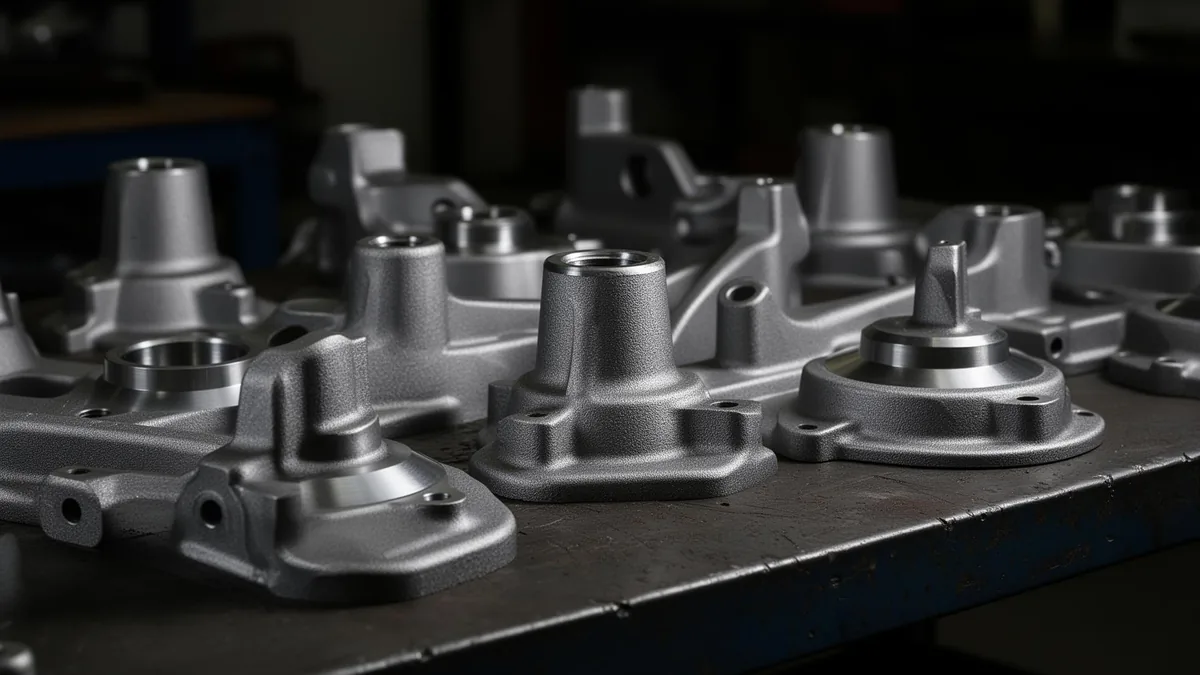
Iron Casting Grades
Grey iron and SG iron grades, cross-standard equivalents, and how a grade is confirmed
Which Grade, and Why It Matters
A grade is a promise about minimum tensile strength, and for SG iron also about elongation. It is the single most consequential line on a casting drawing, because it fixes the chemistry, the melting practice, the heat treatment if any, and the test bar that has to be pulled to prove it.
Sri Gnanamurugan Foundry pours both families: grey iron to IS 210 and spheroidal graphite (ductile) iron to IS 1865, with equivalents to EN 1561 and EN 1563, ASTM A48 and A536, and DIN 1691 and 1693. Castings range from 0.5 kg to 650 kg, so grade and section size are considered together rather than in isolation.
Grey Iron Grades — IS 210
Grey iron is specified by minimum tensile strength in MPa. It machines well, damps vibration, and is the economical choice for housings, frames and bodies that are not heavily loaded in tension.
| IS Grade | EN Equivalent | ASTM | DIN | Min. Tensile (MPa) | Typical Use |
|---|---|---|---|---|---|
| FG 150 | EN-GJL-150 | Class 20 | GG 15 | 150 | Light-duty covers, casings and non-stressed housings |
| FG 200 | EN-GJL-200 | Class 30 | GG 20 | 200 | General engineering castings, pump bodies, brackets |
| FG 220 | EN-GJL-200/250 | Class 30/35 | GG 20/25 | 220 | Intermediate grade for general machine parts |
| FG 260 | EN-GJL-250 | Class 35/40 | GG 25 | 260 | The most widely specified grade: machine beds, frames, housings |
| FG 300 | EN-GJL-300 | Class 45 | GG 30 | 300 | Higher-strength machine tool and hydraulic components |
| FG 350 | EN-GJL-350 | Class 50 | GG 35 | 350 | Heavy-duty applications needing maximum grey iron strength |
| FG 400 | — | Class 60 | — | 400 | Highest grey iron grade, specified for demanding duty |
Spheroidal Graphite Iron Grades — IS 1865
Ductile iron is specified by tensile strength and minimum elongation, written as a pair. The pairing is the point: as strength rises, elongation falls, and choosing a grade means deciding how much shock loading or distortion the part must survive.
| IS Grade | EN Equivalent | ASTM | DIN | Min. Tensile (MPa) | Typical Use |
|---|---|---|---|---|---|
| SG 350/22 | EN-GJS-350-22 | — | — | 350 | Ferritic, maximum ductility and low-temperature impact resistance |
| SG 400/15 | EN-GJS-400-15 | 60-40-18 | GGG 40 | 400 | Ferritic, good elongation and machinability; general engineering |
| SG 450/10 | EN-GJS-450-10 | 65-45-12 | — | 450 | Balanced strength and ductility for automotive and agricultural parts |
| SG 500/7 | EN-GJS-500-7 | — | GGG 50 | 500 | Ferritic-pearlitic; pump and valve bodies, gearbox housings |
| SG 600/3 | EN-GJS-600-3 | 80-55-06 | GGG 60 | 600 | Pearlitic; higher strength for loaded machinery components |
| SG 700/2 | EN-GJS-700-2 | 100-70-03 | GGG 70 | 700 | Pearlitic; wear resistance and high strength |
| SG 800/2 | EN-GJS-800-2 | 120-90-02 | GGG 80 | 800 | High-strength applications replacing cast or fabricated steel |
Grey or Ductile: How the Choice Is Usually Made
Grey iron earns its place where the duty is compressive or vibrational: machine beds, pump bodies, brackets, covers, gearbox housings. Its graphite flakes absorb vibration and its machinability keeps secondary operations cheap. If a drawing says FG 260 and the part is a housing, that is usually the correct call and there is nothing to improve on.
Ductile iron enters when the part has to bend before it breaks, or carry load in tension. Hydraulic and valve bodies, suspension and linkage parts, and components that see impact or thermal cycling are the classic cases. Moving from grey to ductile buys strength and elongation, and costs more in melting control, because magnesium treatment and inoculation have to be right or the graphite does not spheroidise and the test bar tells you so.
A practical rule: if the failure mode you are worried about is cracking rather than wear or distortion, the conversion from grey to ductile is worth costing. If the concern is stiffness and damping in a static frame, grey iron is normally the better engineering answer, not merely the cheaper one.
About the Cross-Standard Equivalents
The EN, ASTM and DIN columns in the tables above are nearest matches, not conversions. The standards differ in test bar diameter, in which properties are guaranteed, and in how the test bar is cast and machined. A 30 mm bar and a 12.5 mm bar from the same heat will not report the same tensile strength, so an exact one-to-one mapping does not exist across standards.
In practice this means: specify the standard you actually need, and confirm the equivalence against your drawing before production rather than assuming it from a table. Where a buyer needs a part to satisfy an ASTM call-out, the grade is agreed in writing before the pattern is mounted.
How the Grade Is Proved
A grade on a drawing becomes a grade on a certificate through four checks, all carried out in house.
Chemistry at the melt
Every heat is checked on the spectrometer before pouring, so composition can still be corrected while the metal is liquid rather than discovered after it has set.
Tensile on the UTM
Test bars are pulled on the universal testing machine and the result is recorded against the batch, which is what the certificate ultimately reports.
Microstructure where it matters
An optical microscope with image analyser is used where the application depends on graphite form or matrix, which is usually a ductile iron question.
Documented and traceable
Results travel with the batch as a Material Test Certificate, numbered by financial year so a certificate can be traced back to the run that produced it.
The certificate format and what each line means is covered on the Material Test Certificate page.
Sending a Grade Requirement
The fastest route to an accurate quotation is a drawing or 3D model together with the grade, the finished weight, and the expected batch or annual quantity. Where the drawing already names an IS, EN, ASTM or DIN grade, that is enough to quote against; where it names a property instead, the equivalent is confirmed with you first.
Questions About Grades
The questions buyers ask most often when comparing Indian and international grade call-outs.
What is the difference between FG 260 and SG 500/7?
FG 260 is a grey iron to IS 210 with a minimum tensile strength of 260 MPa and no guaranteed elongation. SG 500/7 is a spheroidal graphite iron to IS 1865 with a minimum of 500 MPa tensile and 7% elongation. The practical difference is failure behaviour: grey iron is stiff and damps vibration, while SG iron bends before it breaks. The choice follows from whether the part carries load in tension or has to survive shock loading, not from which number is higher.
Can castings be supplied to EN or ASTM specifications instead of IS?
Yes. Castings can be supplied to EN 1561 and EN 1563, ASTM A48 and A536, DIN 1691 and 1693, or the Indian IS 210 and IS 1865 standards. Because these standards differ in test bar size and in which properties are guaranteed, the equivalent is not an exact conversion - the grade is confirmed against the customer drawing before production rather than assumed from a table.
Which grade should I specify for a machine frame or housing?
For a frame or housing whose duty is compressive or vibrational, grey iron in the FG 220 to FG 300 range is the usual engineering answer, because its graphite flakes damp vibration and it machines well. If the same part has to carry tensile load or resist impact, SG iron in the SG 450/10 to SG 500/7 range is the better fit. The grade should follow the failure mode you are designing against.
Is the grade on the certificate the same as the grade on my drawing?
Yes - that is what the certificate certifies. Composition is checked on the spectrometer for every heat before pouring, and mechanical properties are measured on test bars pulled on the universal testing machine, with hardness measured separately. The results for that batch are issued with the goods as a Material Test Certificate in the BIS Annexure-I format under IS 210:2009.